Verification & Validation
Process
Certification is not just an event. It's a process of audits and monitoring that verify compliance. our aim is to make that process as simple and transparent as possible.
Certification Process
With the help and expertise of our team at WECERT, you don't need to be confused by the processes that go into getting certification for your management systems.
From the quality of your management system to the standards governing the health and safety of your workers, ISO certifications are some of the most obvious benchmarks of a business that's serious about maintaining a high-quality product as well as a safe and productive working environment. Plus, for specialized industries — like automotive, telecoms, aerospace and food sectors — there are further certifications specifically tailored to each industry's requirements.
The process for management systems certification is straightforward and typically follows a generic process consistent for ISO management systems standards.
There are minor differences for specific standards such as AS9100 (aerospace quality management standard) and IATF 16949 (automotive quality management standard), which we will be happy to explain during your application journey.
Certification Process
ISO Certification Process
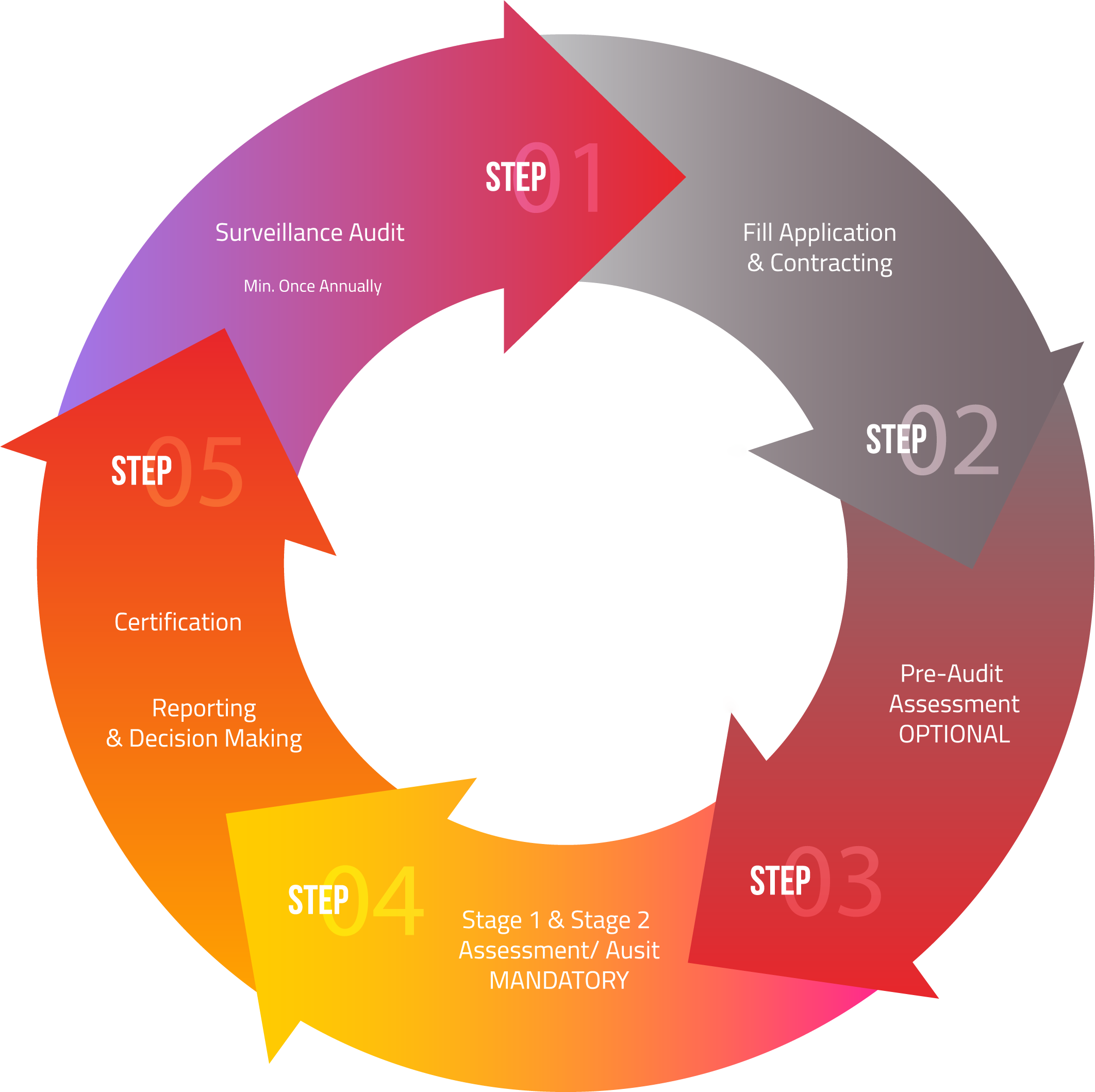
The certification process typically comprises seven distinct steps. It is generally a three-year program consisting of initial certification followed by surveillance audits at the one- and two-year marks, then recertification after three years. The process and its timeline are largely determined by the relevant accreditation body.
Step 1: CERTIFICATION PROGRAM SET-UP
WECERT partners with you to devise the right certification program based on your organization's particular needs and priorities. This means determining which management systems to audit, and for how many sites.
You will need to fill in an application form (also known as a Initial Questionnaire) in order for us to understand your company, the complexity and requirements. You can do this by completing our online Application Form. We will use this information to accurately define the scope of assessment and provide you with a proposal for certification.
Please note that you must be able to demonstrate your management system has been fully operational for a minimum of three months and has been subject to a management review and full cycle of internal audits.
Also there may be additional requirements for some of the more technical standards – we will advise you of these.
Step 2: Pre-Audit & Assessment
Once you've agreed with your proposal, your assessments will be booked with one of our Assessor. This assessment consists of two mandatory visits that form the Initial Certification Audit.
The pre-audit is an optional audit that evaluates your management system against specific requirements of the standard to which you are seeking certification. We will provide a report detailing all the findings during the pre-audit, the findings are usually the weakness points against the standard requirements which by focusing on them the organization may anticipate more success during its assessment stages.
Step 3: Initial Certification Audit — Stage 1
The purpose of this assessment is to confirm that your organization is ready for full assessment. This assessment will take place at your management system centre (normally head office) and will be a documentation review assessment.
During the stage 1 assessment, our assessor will:
- confirm the accuracy of the information that you submitted during the application process
- confirm that the management system conforms to the requirements of the standard
- confirm the implementation status of your management system(s)
- confirm the scope of certification
- verify the evaluation of legal compliance
The output of the stage 1 assessment will be:
- a report that identifies any Areas of Concern (AOC's) which, if not addressed, could be raised as non-conformances at the stage 2 assessment
- the scheduling of the stage 2 assessment visit
- an assessment plan for the stage 2 assessment
Step 4: Initial Certification Audit — Stage 2
The purpose of this assessment is to confirm that the management system fully conforms to the requirements of the chosen standard in practice. If you undertake site work, or have more than one location that you want within the scope of your certification then your assessor will also need to audit these activities / locations.
During the stage 2 assessment, your assessor will:
- document how the system complies with the standard by using objective evidence
- undertake sample audits of the processes and activities defined in the scope of certification
- visit any remote locations, additional sites or remote activities to evaluate the effectiveness of the management system off site
- report any non-conformities or opportunities for improvement
- produce a surveillance plan and agree a date for the first annual surveillance visit
If the assessor identifies any major non-conformances, certification cannot be issued until corrective action is taken and verified. Accreditation requirements stipulate that if this is not completed within 6 months, then certification cannot be recommended without a further stage 2 assessment.
This requirement extends to any nonconformity regarding the internal audit or management review processes. Certification may not be issued until there is sufficient evidence to demonstrate that arrangements for management reviews and internal audits have been implemented, are effective and will be maintained.
Step 5: Certification
Following a successful two stage audit, it's determined whether your operations and processes meet the required scope of certification within the applicable standard or standards. Consequently, a certification decision is made and if positive, certification to the required standard is issued by WECERT.
Certification is valid for three years and is maintained through a program of annual surveillance audits and a three yearly recertification audit.
You will receive a hard and soft copy of the certification. That copy will enable you to share your certification with third parties to demonstrate the high standards your organization adheres to.
Step 6: Surveillance
Surveillance audits shall be conducted at least once a calendar year, except in recertification years. The date of the first surveillance audit following initial certification shall not be more than 12 months from the certification decision date.
Step 7: Recertification
Full certification reassessment takes place automatically every three years to ensure ongoing conformity. This must be completed before expiry of the existing Certificate of Approval. Careful scheduling of the recertification audit is crucial to avoiding lapses in certification.
How Long Is Certification Valid?
Once certification is obtained a certificate will be issued that will be valid for 3 years. This is maintained through annual surveillance audits (partial audits) and a 3 year recertification audit (full system audit).
Surveillance audits are undertaken annually to ensure that compliance to the chosen Standard(s) is maintained throughout the three year certification cycle.
The frequency and duration of surveillance is dependent on factors including:
- size and structure of organization
- complexity and risk of activities
- number of management systems standards included in the scope of certification
- number of sites listed within the scope of certification
During the surveillance audit you must demonstrate continual improvement. This is a fundamental requirement of all ISO standards.
SUSPENSION, WITHDRAWAL CANCELLATION OR RESTORATION OF THE CERTIFICATE
WECERT might suspend, withdraw, reduce, extend or cancel the Certificate of Approval at any time and shall give the client written notice. If such actions are deemed necessary by WECERT, the client will be fully briefed and will be given every possible opportunity to take corrective action before a final decision is taken on what action WECERT should take after the expiration of such notification period. Unannounced visits may also be conducted as a follow up on clients which certification has been suspended. Suspension is lifted and certification is restored upon satisfactory clearance of non-conformities and verification by WECERT of the compliance of client's management system.