
ISO 14064-1 Corporate Carbon Footprint Verification

WECERT provides independent verification of organization-level greenhouse gas inventories and corporate carbon footprint reports based on ISO 14064-1 and ISO 14064-3 verification principles.

ISO 14064-1 verification helps organizations demonstrate that their reported greenhouse gas emissions, boundaries, activity data, emission factors, calculations, assumptions, and supporting evidence have been independently reviewed against defined criteria.

ISO 14064-1

GHG Inventory Reporting

ISO 14064-3

Verification of GHG Statements

Scope 1

Direct GHG Emissions

Scope 2

Energy indirect Emissions

Scope 3

Other indirect Emissions

Verification Output

Report, Statement or Certificate

What Is ISO 14064-1 Verification?

ISO 14064-1 verification is an independent review of an organization’s GHG inventory report, corporate carbon footprint calculation, reporting boundaries, emission sources, activity data, emission factors, assumptions, exclusions, uncertainty, and supporting evidence.

The objective is to determine whether the reported greenhouse gas information is complete, consistent, traceable, and materially correct against the agreed verification criteria.

Verification does not only check the final emissions number. It reviews the reliability of the information behind the number, including source records, calculation files, boundary decisions, emission factor references, and the organization’s internal review of GHG information.

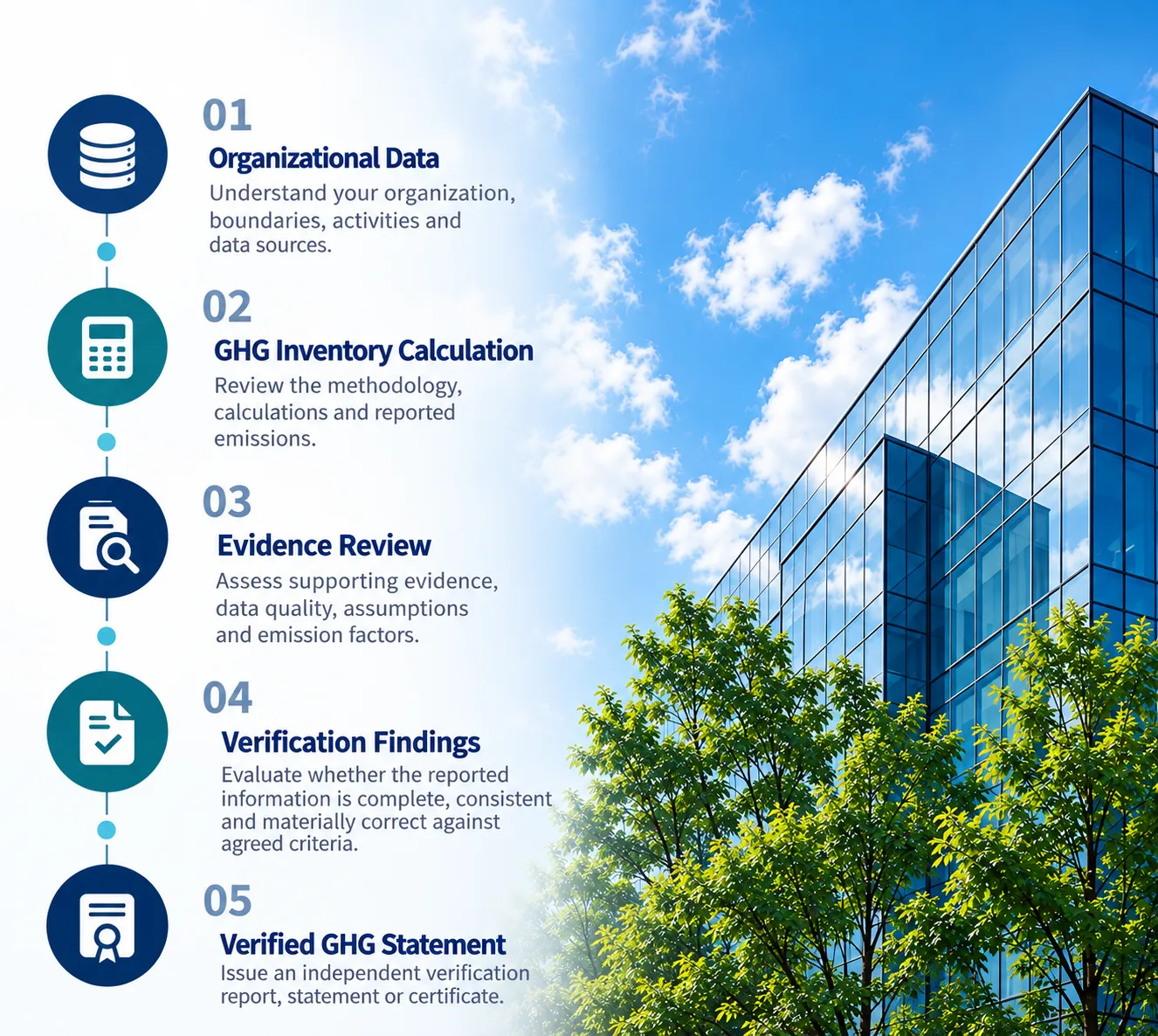
Organizational Data

GHG Inventory Calculation

Evidence Review

Verification Findings

Verified GHG Statement

ISO 14064-1 is used for organization-level quantification and reporting of greenhouse gas emissions and removals. It provides a structured basis for preparing corporate GHG inventories, defining boundaries, identifying emission sources, selecting calculation methods, and reporting GHG information.

Who Needs ISO 14064-1 Verification?

ISO 14064-1 verification is useful for organizations that need credible, independently reviewed corporate GHG information.

Companies Preparing ESG Reports

Verification supports reliable organization-level carbon data for ESG reports, sustainability disclosures, and climate-related communication.

Manufacturing Organizations

erification of GHG inventories related to production facilities, energy use, fuel consumption, process emissions, and operational activities.

Exporters and Suppliers

Verification of corporate carbon footprint information requested by international customers, supply-chain partners, and procurement bodies.

Energy-Intensive Industries

Verification for organizations with significant electricity, fuel, thermal energy, or process-related emissions.

Logistics and Transport Companies

Verification of emissions related to fleet fuel consumption, transportation operations, facilities, and purchased energy.

Corporate Groups and Multi-Site Organizations

Verification of GHG inventories covering multiple sites, business units, facilities, or operational locations.

Food and Beverage Companies

Verification of emissions from production sites, cold chain operations, energy use, fuel consumption, logistics, and support activities.

Organizations Setting Carbon Reduction Targets

Verification provides a more reliable baseline for reduction targets, decarbonization plans, and performance monitoring.

Scope 1, Scope 2 and Scope 3 in Corporate Carbon Footprint Verification

Corporate carbon footprint verification may include Scope 1, Scope 2, and relevant Scope 3 emissions depending on the reporting boundary, intended use, verification criteria, and available evidence.

Scope 1 — Direct GHG Emissions

Direct emissions from sources owned or controlled by the organization, such as fuel combustion, company vehicles, process emissions, generators, boilers, furnaces, and refrigerant leakage.

Scope 2 — Energy Indirect GHG Emissions

Indirect emissions from purchased electricity, steam, heating, or cooling consumed by the organization.

Scope 3 — Other Indirect GHG Emissions

Other indirect emissions occurring in the organization’s value chain, such as purchased goods and services, logistics, business travel, employee commuting, waste, outsourced activities, use of sold products, and end-of-life treatment.

The verification scope should clearly define which emission categories are included, which are excluded, and how the organization justifies its reporting boundary.

Searching for an ISO 14064 Certificate?

Many organizations search for an “ISO 14064 certificate” or “ISO 14064 certification” when they need formal evidence that their corporate GHG inventory or organization-level carbon footprint report has been independently verified.

In practice, ISO 14064-1 is used for preparing and reporting an organization-level GHG inventory, while ISO 14064-3 is used for verification and validation of greenhouse gas statements. Therefore, the appropriate output is usually a GHG inventory verification statement, verification report, or corporate carbon footprint verification certificate, depending on the agreed verification scope and criteria.

WECERT supports organizations that need independent verification evidence for ISO 14064-1 GHG inventories, ESG reporting, customer requirements, sustainability disclosures, tender submissions, and corporate carbon management.

Corporate GHG Inventory Verification Statement

Based on ISO 14064-1 and ISO 14064-3

Verified Scope: Corporate GHG Inventory Report
Criteria: ISO 14064-1 / ISO 14064-3
Output: Verification Statement / Report / Verification Certificate
Verification Result: Issued after successful verification

What WECERT Verifies

WECERT verifies the data, boundaries, calculation methods, assumptions, emission factors, and evidence behind the organization’s corporate GHG inventory.

GHG Inventory Report

  • Corporate carbon footprint report
  • GHG inventory statement
  • Reporting period
  • Base year information
  • Final approved GHG report

Organizational Boundary

  • Legal entities
  • Sites and facilities
  • Operational control
  • Financial control, where applicable
  • Boundary justification

Operational Boundary

  • Scope 1 emissions
  • Scope 2 emissions
  • Relevant Scope 3 categories
  • Included and excluded sources
  • Emission source identification

Activity Data

  • Electricity consumption
  • Fuel consumption
  • Vehicle fuel records
  • Refrigerant records
  • Production and operational data
  • Waste and logistics data, where applicable

Emission Factors and Calculations

  • Emission factor references
  • Conversion factors
  • Global warming potential values
  • Calculation formulas
  • Assumptions and exclusions
  • Uncertainty and data quality

Supporting Evidence

  • Emission factor references
  • Conversion factors
  • Global warming potential values
  • Calculation formulas
  • Assumptions and exclusions
  • Uncertainty and data quality

Corporate Carbon Footprint Verification Process

WECERT follows a structured verification process to review the organization’s GHG inventory and supporting evidence before issuing the agreed verification output.

Inquiry and Scope Confirmation

WECERT reviews the organization, sites, reporting period, intended use, GHG inventory boundary, selected criteria, and expected verification output.

Contract Review and Planning

The proposed verification scope is reviewed, and the verification plan is prepared, including criteria, level of assurance, materiality, required evidence, verification activities, and competence needs.

Document and Data Review

The verification team reviews the GHG inventory report, calculation files, activity data, emission factors, boundary statement, assumptions, exclusions, and supporting records.

Risk Assessment and Sampling

Areas where material misstatement may occur are identified, and samples of emission sources, records, calculations, and supporting evidence are selected for review.

Findings and Corrections

Findings related to errors, omissions, unsupported data, unclear assumptions, or inconsistent calculations are communicated for correction before final conclusion.

Final Verification Output

After verification activities and final review are completed, WECERT issues the agreed output, such as a verification report, verification statement, or corporate carbon footprint verification certificate.

Why Choose WECERT for Corporate Carbon Footprint Verification?

WECERT provides independent conformity assessment, certification, verification, validation, inspection, and training services for organizations seeking credible evidence of compliance and performance. For corporate carbon footprint verification, WECERT combines technical understanding of greenhouse gas reporting, management system auditing, conformity assessment principles, evidence-based verification, and sector-specific operational knowledge.

Independent Verification Approach

Evidence-based review of GHG data, boundaries, calculations, assumptions, and supporting records.

ISO 14064-Based Methodology

Verification activities aligned with ISO 14064-1, ISO 14064-3, and agreed verification criteria.

Scope 1, Scope 2 and Scope 3 Understanding

Verification planning considers direct emissions, energy indirect emissions, and relevant value-chain emission categories.

Sector-Specific Knowledge

Suitable for manufacturing, food, logistics, construction materials, hospitality, exporters, suppliers, and energy-intensive organizations.

Clear Verification Output

Verification output may include a report, GHG inventory verification statement, or corporate carbon footprint verification certificate.

Support for ESG and Market Confidence

Verified corporate carbon data can support ESG reporting, customer requirements, supply-chain transparency, tenders, and climate communication.

Benefits of Corporate Carbon Footprint Verification

Independent verification helps organizations improve the credibility, reliability, and usefulness of their corporate greenhouse gas information.

Strengthen GHG Inventory Credibility

Demonstrate that the corporate GHG inventory has been independently reviewed against defined criteria, boundaries, methods, and supporting evidence.

Support ESG and Sustainability Reporting

Use verified organization-level carbon data to support ESG reports, sustainability disclosures, climate-related communication, and stakeholder reporting.

Respond to Customer Requirements

Provide customers, procurement teams, investors, and supply-chain partners with more credible corporate carbon footprint information.

Improve Emission Source Understanding

Verification helps organizations identify data gaps, calculation weaknesses, major emission sources, and areas needing stronger internal controls.

Support Carbon Reduction Planning

Verified GHG data provides a more reliable basis for carbon reduction targets, decarbonization strategies, performance monitoring, and improvement actions.

Reduce Unsupported Climate Claims

Verification helps reduce the risk of inaccurate, incomplete, or unsupported climate-related statements in reports, tenders, and external communication.

Corporate carbon footprint verification does not automatically reduce emissions. However, it improves the reliability of the information used for emissions management, reduction planning, climate-related decision-making, and external communication.

Still have questions? We have answered the most common questions organizations ask before applying for ISO 14064-1 Verification.

ISO 14064-1 Verification FAQ

Whether you are implementing a corporate Carbon Footprint verification for the first time, the following questions address some of the most common topics organizations inquire about before embarking on their certification journey.

Corporate carbon footprint verification is an independent review of an organization-level GHG inventory or carbon footprint report. It evaluates whether reported emissions data, boundaries, calculation methods, assumptions, emission factors, and supporting evidence are complete, consistent, traceable, and materially correct against the agreed criteria.

ISO 14064-1 is used for organization-level quantification and reporting of greenhouse gas emissions and removals. It supports the preparation of corporate GHG inventories and organization-level carbon footprint reports.

ISO 14064-3 provides requirements and guidance for verification and validation of greenhouse gas statements. It is used to support the independent verification of GHG inventory reports and other GHG statements.

Many clients use the phrase “ISO 14064 certificate” when they need formal verification evidence for a corporate GHG inventory. The appropriate output may be a GHG inventory verification statement, verification report, or corporate carbon footprint verification certificate depending on the agreed scope and criteria.

The verification scope may include Scope 1, Scope 2, and relevant Scope 3 emissions depending on the organization’s reporting boundary, selected criteria, intended users, and available evidence.

Typical documents include the GHG inventory report, calculation files, boundary statement, electricity records, fuel records, refrigerant records, vehicle records, emission factor references, assumptions, exclusions, uncertainty assessment, and supporting evidence.

It may not be mandatory in every ESG reporting situation, but it is strongly useful when organizations need reliable, transparent, and credible greenhouse gas information for ESG reports, customer submissions, investors, tenders, and sustainability communication.

Corporate carbon footprint focuses on the emissions and removals of an organization. Product carbon footprint focuses on the emissions associated with a specific product or service across defined life cycle stages.

The output may include a verification report, GHG inventory verification statement, or corporate carbon footprint verification certificate depending on the agreed scope, criteria, and verification conclusion.

Verification itself does not reduce emissions. However, it improves the reliability of GHG data, which helps organizations identify emission sources, improve data quality, set reduction targets, and monitor carbon reduction actions.

Ready to Verify Your

ISO 14064-1 GHG Inventory?

Share your corporate GHG inventory, ISO 14064-1 report, calculation file, activity data, or organization-level carbon footprint report with WECERT for verification scope review and proposal preparation.
WECERT can review your verification requirements and help define the appropriate scope, criteria, reporting period, evidence needs, and verification output.